|
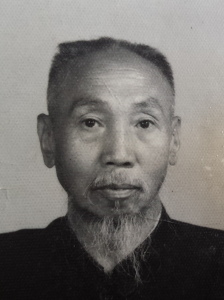
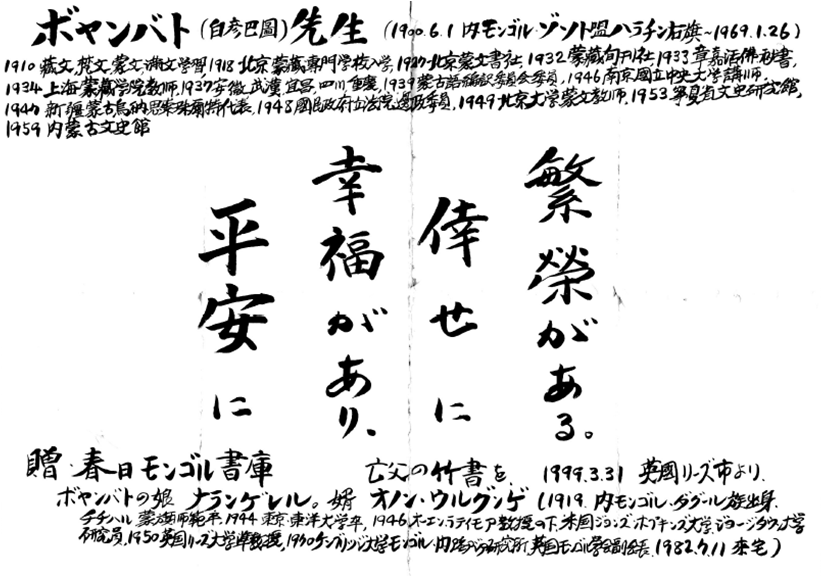
Bayenbatur, of the clan Eltuud, was born on June 1st 1900 |
|
He could speak Mongol, Mandarin Chinese, Manchu and Tibetan. Having started to learn the Tibetan scriptures and Manchu aged 11, he went to the Banner school at 15 and initially worked in the Banner's Office of the Noyen (equivalent of UK Lord Lieutenant). He was then sent to a Peking school of Chinese, Tibetan and Mongol at the age of 18 and, whilst there, joined the May 4th Students Rebellion in 1919. |
| 1923 - Took the "Civil Service" exams at the Peking Home Office, coming 6th in languages |
| 1927 - The Japanese government asked him to go to Osaka to teach Mongol and Manchu, but he declined. |
| 1931 - Moved to Nanking where he became a translator for a Mongol & Tibetan magazine |
| 1934 - Worked as a language translator for Chiang Kai Shek's magazine, then translated for the Tibetan Rinpoche School in Shanghai. He edited and translated works on Sun Yat-Sen into Mongol and Tibetan. Returning to Nanking in the war year of 1937. |
| 1938 - Worked for the Mongol Banner office in Szu-chuan, and then worked as a translator for the "border lands" (ie Inner Mongolia) on topics such as politics, culture, education and social sciences. |
| 1946 - He became a lecturer at Nanking Central University Law School on Etnic Minority Governments. |
| 1947 - Following the takeover by Mao Tse-tung, Bayenbatur became a Mongol translator of Chinese laws for the Xinjiang Mongol Noyen. |
| 1949 - Lecturer at Nanking & Peking University of Oriental Languages, in Mongol |
| 1950 - Wrote a Mongol grammar |
| 1953 - Translator for Mongol Ethnic Minorities |
| 1955 - Cultural & History Institue research fellow in Ningxia |
| 1959 - 1968 - Inner Mongolia Culture & History Research Institute |
| 1969 - Bayenbatur was a follower of Buddhism all his life, reading both Tibetan and Sanskrit scriptures. |
| He died on Jan 26th 1969 |
Prof. Kasega translated this history from documents in Bayenbatur's archive. |
 |